Pay in installments of $7.47 with
 ,
,
 and
and

Shipping Estimate
USA
- USA
- CAN
- USA
- CAN
Ships within 48 hours · Estimated delivery Jul 2 - Jul 7
 Promo Codes Available:
For Your Every Summer RSVP, with Code: SUMMER15
Description
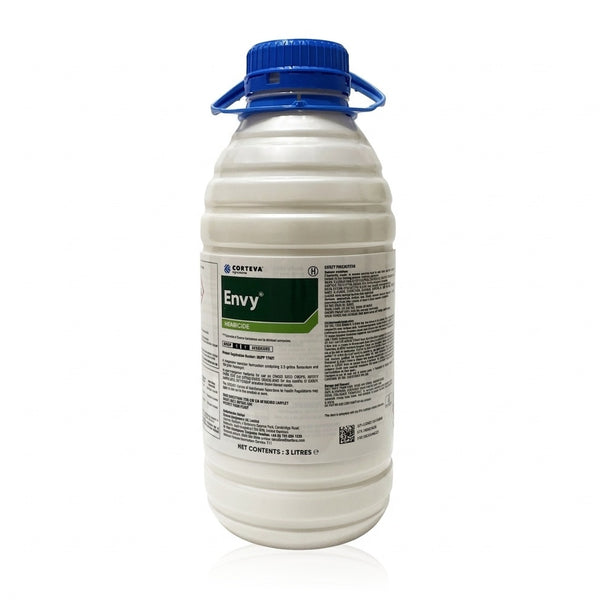
envy herbicide label Envy® Herbicide Weed Killer 3LWeeds Controlled Product Overview Type of Product Herbicide Product Name Envy MAPP No. 17901 Active Substance 100g l fluroxypyr 2. 5g l florasulam Formulation Type Suspension Emulsion Areas of Use Established, newly sown & seed crop grassland Amateur Professional Professional Recommended Spraying Essentials MAPP 17901 Active Substances: 2g l Florasulam and 100g l Fluoxypyr Envy is a systemic penetrant selective herbicide containing 2g l Florasulam and
| Weeds Controlled |
|---|
| Product Overview | |
|---|---|
| Type of Product | Herbicide |
| Product Name | Envy® |
| MAPP No. | 17901 |
| Active Substance | 100g/l fluroxypyr 2.5g/l florasulam |
| Formulation Type | Suspension Emulsion |
| Areas of Use | Established, newly sown & seed crop grassland |
| Amateur/Professional | Professional |
| Recommended Spraying Essentials |
|---|
MAPP 17901
Active Substances: 2g/l Florasulam and 100g/l Fluoxypyr
Envy is a systemic penetrant selective herbicide containing 2g/l Florasulam and 100g/l Fluoxypyr for the control of herbaceous perennial broadleaved weeds in established, newly sown and seed crop grassland. It can be applied once per year at a rate of 1-2L/ha.
Envy contains two active substances to actively target and control problem annual and perennial weeds such as buttercups, dandelions, docks and daisies in paddocks, low productivity grassland and pastures.
Envy is effective in cool weather conditions and is therefore a useful replacement for straight fluoxypyr to control chickweed early in the growing season.
Because it has a short stock exclusion time of just 7 days, Envy is particularly useful for controlling weeds in horse paddocks and fields.
Manure from horses grazed on paddocks and fields treated with Envy can be used on gardens or allotments with no residue concerns.
3 Litre pack treats 3.7 acres at 2.0L/ha
Instructions for use
Where to use
- Grassland - Short and long-term grass leys and permanent pasture, which may be grazed and /or cut for subsequent animal consumption. Includes use on newly sown leys and moorland for grazing
When to use
Apply when weeds are actively growing.
- For new sown leys and established grassland apply between 1st February and 30th November
- For grass grown for seed apply between 1st March and 30th November
| Application Window - Envy® is authorised for a maximum of one application in one year | |||||||||||
|---|---|---|---|---|---|---|---|---|---|---|---|
| Jan | Feb | Mar | Apr | May | Jun | Jul | Aug | Sep | Oct | Nov | Dec |
How to use
- Apply at a rate of:
- 2L/ha for established grassland
- 1 - 1.5L/ha for newly sown leys
- 1 - 1.5L/ha for grass grown for seed
- Apply using a vehicle mounted hydraulic sprayer
| Crops | Maximum Treatments | Application Method | Application Rate | Water Volume | Spray Quality |
|---|---|---|---|---|---|
| Established grassland | 1 per year | Vehicle mounted hydraulic sprayer or knapsack sprayer | 2L/ha | 200 - 400 L/ha | Medium |
| Newly sown leys | 1 - 1.5L/ha | 200L/ha | |||
| Grass grown for seed | 1 - 1.5L/ha | 200L/ha |
Additional Information
- Livestock must be kept out of treated areas for at least 2 weeks following treatment and if ragwort is present, until there is no visible sign of the dead weed
- Do not spray when grass is wet, if night time temperatures are low, if ground frost is imminent or in prolonged cold or dry weather
- Avoid contact with non-target plants
- Do not allow drift to contact water
- Allow four weeks before re-seeding
- Do not roll or harrow grass for 10 days before or 7 days after application
- Envy will kill or severely control clover
- Ensure grass has become established before spraying: grass sown in spring or summer may be ready for spraying after about 2 months but grass sown in late summer or autumn should not be sprayed until growth is resumed in the following spring
Active substances
Fluoxypyr
Bio-Chemical Mode of Action: Fluoxypyr belongs to the synthetic auxins group of herbicides.
Synthetic auxins work by inducing rapid abnormal cell growth and development in the stems, petioles and leaves of susceptible plants causing cell bursts and ultimately cell and plant death.
Mobility: Fluoxypyr is a systemic penetrant which means that the active substance can be translocated downwards through the plant within the phloem (sugar conducting tissues) and upwards through the plant within the xylem (water conducting tissues).
Application timing: Systemic auxins are best applied when the weeds are actively growing. They are generally more effective when target plants are younger and in their vegetative phases.
Resistance: The incidences of resistance to synthetic auxins remains relatively low which is assumed to be because the herbicide has multiple sites of action.
However, resistance to synthetic auxins has been observed globally with 36 species being confirmed as resistant as of 2017. Best management practices, such as alternating with products with a different mode of action and using cultural weed control methods, will help to reduce the risk of further resistance.
Florasulam
Bio-Chemical Mode of Action: Florasulam belongs to the ALS (Acetolactate Synthase) Inhibitors group of herbicides.
Acetolactate synthase is an important enzyme involved in the biosynthesis of branched-chain amino acids. ALS inhibitors interrupt this process causing the plant to initially become chlorotic before necrosis of plant tissues followed by whole plant death occurs.
Mobility: Florasulam is a systemic penetrant which means that the active substance can be translocated downwards through the plant within the phloem (sugar conducting tissues) and upwards through the plant within the xylem (water conducting tissues).
Application timing: ALS inhibitors are best applied when the weeds are actively growing. They are generally more effective when target plants are younger and in their vegetative phases.
Resistance: Resistance to ALS inhibitors is a relatively frequent occurrence due to their high activity on sensitive biotypes and soil residual activity. Best management practices, such as alternating with products with a different mode of action and using cultural weed control methods, will help to reduce the risk of further resistance.
Shipping Notes
- Free Standard Shipping on $100+ Orders to the USA.
- Except Preorder products are shipped in 48 hours.
- Delivery to the USA:
- Standard Shipping : 3-10 business days
- If time is of the essence, please consider selecting expedited delivery for faster service.
Exchange/Return Notes
- We offer a 30-day return/exchange service after receiving.
- Final sale items are not eligible for returns or exchanges.
- To process your return/exchange, please contact us at [email protected]
- Please click here for more details>>> Return & Exchange Policy